Africa’s Digital Infrastructure Race: What Will Define the Next Decade?
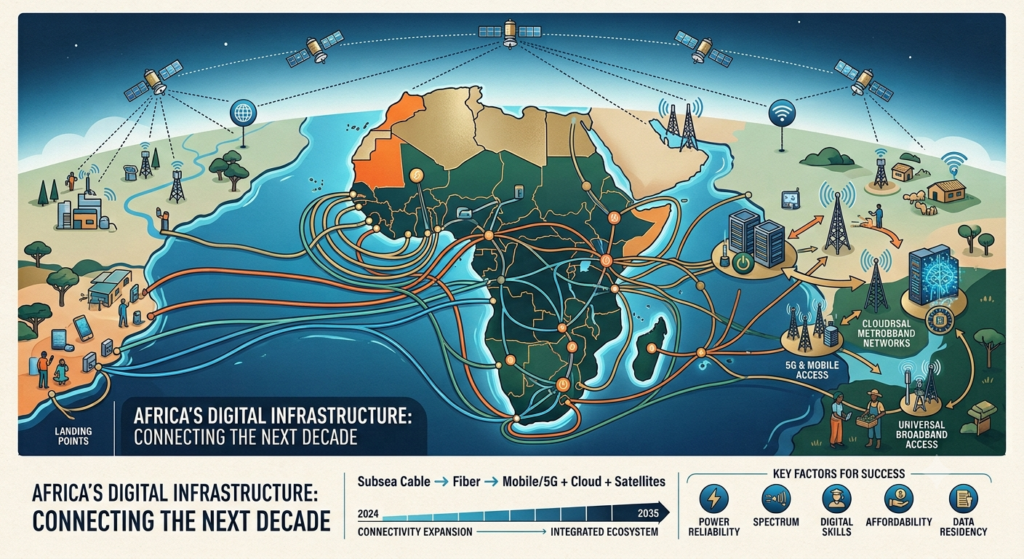
From subsea cables and 5G to cloud, satellites and AI compute, the infrastructure decisions being made today could determine Africa’s position in the global digital economy by 2035.
Africa’s digital transformation is entering a new phase.
For much of the past two decades, the central challenge was connectivity: getting more people online, expanding mobile coverage and bringing international bandwidth to a continent where communications infrastructure remained comparatively limited.
That challenge has not disappeared. But the infrastructure equation is becoming considerably more complex.
By 2035, digital competitiveness will increasingly depend not simply on whether a country is connected, but on the quality, resilience and intelligence of the infrastructure behind that connection. Subsea cables must connect to national fiber networks. Mobile networks must evolve from 4G towards 5G and beyond. Data must increasingly be stored and processed closer to users. And the rapid development of artificial intelligence is creating another requirement altogether: access to large-scale computing power.
The result is an emerging digital infrastructure race that could reshape Africa’s economic geography over the next decade.
Subsea cables are changing Africa’s international connectivity
At the international level, Africa has already experienced a remarkable expansion of subsea connectivity.
One of the most significant additions is 2Africa, a 45,000-kilometre subsea cable system designed to connect Africa, Europe and Asia. Its core systems were completed in 2025, and the project says the network will ultimately facilitate connectivity for more than three billion people across 33 countries.
Google’s Equiano cable has meanwhile created another high-capacity route along Africa’s western coastline, connecting Portugal with landing points including Togo, Nigeria, Namibia, South Africa and St Helena.
More routes are coming. Google has also announced Umoja, a new fiber-optic route beginning in Kenya and travelling terrestrially through Uganda, Rwanda, the Democratic Republic of Congo, Zambia, Zimbabwe and South Africa before crossing the Indian Ocean to Australia.
These systems can dramatically increase international capacity and improve resilience. But landing cables on African shores solves only part of the problem.
The next priority is moving that capacity inland.
Landlocked countries and secondary cities require extensive terrestrial fiber, cross-border connections, metropolitan networks and competitive wholesale infrastructure. The World Bank estimated in 2019 that achieving universal broadband access across Africa by 2030 would require approximately 250,000 kilometres of additional fiber alongside nearly 250,000 new 4G base stations.
The infrastructure race therefore increasingly moves from the coastline into the continent.
Mobile remains the foundation
For hundreds of millions of Africans, the mobile network will remain the primary gateway to the digital economy.
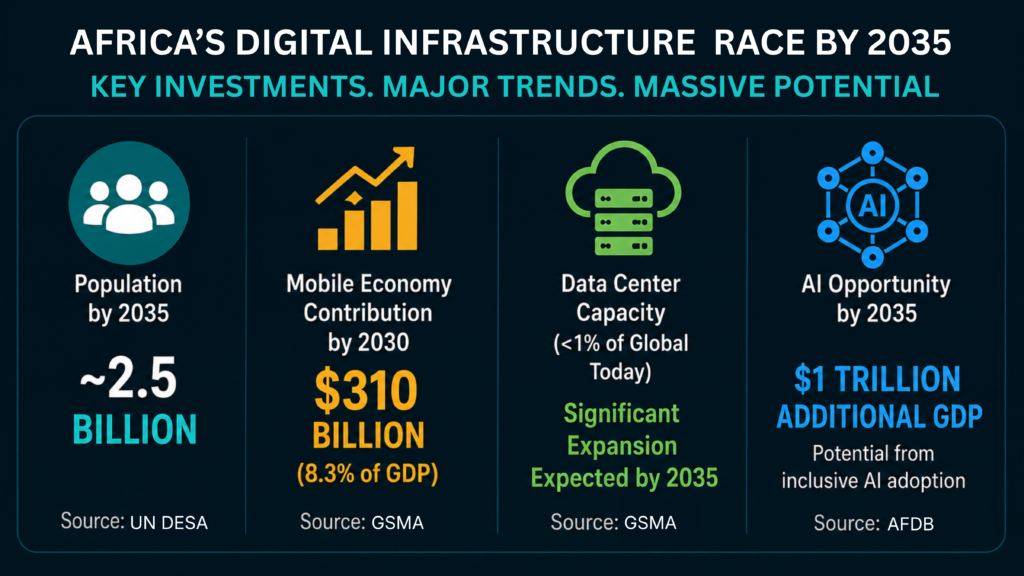
According to the GSMA, mobile technologies and services contributed approximately $240 billion to Africa’s economy in 2025, equivalent to 7.8% of GDP. Operators are expected to invest more than $76 billion in network infrastructure between 2024 and 2030, while 5G adoption is forecast to reach 21% of mobile connections by 2030.
Yet Africa faces an unusual paradox.
The GSMA estimates that around 63% of Africans live within mobile broadband coverage but do not use mobile internet, while only 9% remain outside mobile broadband coverage altogether.
That distinction matters.
Building infrastructure remains essential, but infrastructure alone cannot deliver digital transformation. Smartphone affordability, data prices, digital skills and locally relevant services increasingly determine whether available networks translate into meaningful economic participation.
At the same time, 5G — and eventually 5G-Advanced — will become increasingly important in major urban and industrial markets. Beyond faster smartphones, these networks can support fixed wireless access, enterprise connectivity, industrial applications and the low-latency services that emerging digital economies will require.
Satellites can fill the geography gap
Terrestrial networks, however, cannot economically reach every community.
Africa’s vast geography, dispersed rural populations and difficult terrain make satellite connectivity an increasingly important part of the infrastructure mix.
Low-Earth-orbit satellite systems are changing the economics of satellite broadband, creating new possibilities for remote communities, mines, farms, schools and businesses far from fiber networks.
The long-term opportunity is therefore unlikely to be a contest between satellite and terrestrial operators. It is more likely to be a hybrid architecture.
Fiber will carry enormous volumes between cities, countries and data centers. Mobile networks will provide mass-market access. Satellites can extend coverage into areas where terrestrial deployment remains uneconomic or provide redundancy when terrestrial infrastructure fails.
By 2035, the strongest digital markets may be those that successfully integrate all three.
The next bottleneck: data centers and cloud
Connectivity also creates another requirement: somewhere for Africa’s rapidly growing volume of data to be processed and stored.
Here, the infrastructure gap remains substantial.
The GSMA noted in 2025 that Africa, despite being home to roughly 18% of the world’s population, accounts for less than 1% of global data-center capacity.
Progress is nevertheless accelerating.
Microsoft opened Azure cloud regions in Johannesburg and Cape Town in 2019. AWS opened its Africa region in Cape Town in 2020, while Google Cloud opened its first African cloud region in Johannesburg in 2024.
The next decade should see the data-center map broaden beyond its heavy concentration in South Africa as markets such as Kenya, Nigeria, Egypt and Morocco develop larger digital ecosystems.
That matters for more than latency. Local infrastructure can support data residency, cybersecurity, financial services, government platforms and increasingly sophisticated enterprise workloads.
But data centers require something telecommunications infrastructure alone cannot provide: enormous quantities of reliable electricity.
As cloud and AI infrastructure expands, power availability may become one of the decisive factors determining where Africa’s digital hubs emerge.
AI changes the infrastructure equation
Artificial intelligence raises the stakes further.
The previous digital divide was principally about access to communications networks. The emerging divide could increasingly be about access to compute.
Training and operating advanced AI systems requires GPUs, high-performance data centers, cloud infrastructure, reliable power and large datasets. Africa currently has limited capacity in several of these areas.
The African Development Bank estimates that inclusive adoption of AI could generate as much as $1 trillion in additional African GDP by 2035. But its roadmap identifies data, compute infrastructure, skills, governance and investment as essential foundations for capturing that opportunity.
Without local computing infrastructure, African companies, researchers and governments risk remaining dependent on computing resources located elsewhere.
That makes investment in AI-ready data centers, regional GPU capacity, cloud platforms and energy infrastructure strategically significant.
What will matter most by 2035?
Africa does not need to choose between subsea cables, fiber, mobile, satellites, cloud or AI infrastructure. These technologies form layers of the same digital ecosystem.
The real competitive advantage will come from connecting them.
A subsea cable delivers limited economic benefit if inland fiber cannot distribute its capacity. Fiber has limited value without affordable last-mile access. 5G cannot reach its potential without fiber backhaul, spectrum and cloud infrastructure. Cloud platforms require data centers. AI requires compute. And almost everything ultimately depends on reliable and increasingly sustainable electricity.
The countries that understand these interdependencies will have an advantage.
By 2035, Africa’s most important digital infrastructure may therefore not be a single cable, satellite constellation, data center or mobile network.
It will be the architecture that connects them all.
And the race to build that architecture has already begun.